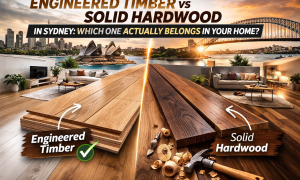
These two flooring options are constantly compared, and the confusion is understandable because, from above, they can look virtually identical. Here is what actually separates them before we get into the details:
Engineered timber has a real hardwood top layer bonded over a multi-layer core, which is what makes it handle Sydney’s humidity without throwing a tantrum
Solid hardwood is one solid piece of natural timber all the way through, which means you can sand and refinish it more times than you will probably ever need to
Sydney’s climate is genuinely tough on timber floors and the suburb you live in changes which option makes more sense
Cost, subfloor type, how long you plan to stay, and what the property actually is all feed into this decision in different ways
Right, let us get into it properly.
Why Sydney Makes This Decision More Complicated Than It Should Be
Walk into any Sydney flooring showroom and ask which option is better and you will get a very confident answer from whoever is working that day. The problem is that the answer changes depending on which showroom you walk into.
Here is what nobody tells you upfront. Sydney does not have one climate. It has several. The humidity sitting over Bondi on a February afternoon is genuinely different from what Penrith is dealing with on the same day. A Newtown terrace with single brick walls and no ducted air conditioning behaves completely differently from a brand-new apartment in Rhodes with floor-to-ceiling glazing and reverse-cycle running twelve months a year. What works brilliantly in one of those situations can cause real problems in another.
Add to that the fact that Sydney’s property market means flooring is never just a comfort decision. It is a financial one. People here spend serious money on their floors and they expect that money to show up in how the property presents and eventually what it sells for. Getting this wrong is not just an aesthetic annoyance. It costs real dollars.
So let us actually talk about both options honestly, without the showroom spin.
What Engineered Timber Flooring Actually Is
There is a persistent misconception floating around Sydney renovation circles that engineered timber is somehow fake or a budget compromise. It is neither of those things and that misunderstanding leads people to make decisions that do not serve them well.
How It Is Built and Why That Matters
An engineered timber board has a genuine hardwood veneer on top, anywhere from two millimetres to six millimetres thick depending on the product, and underneath that sits a core made from multiple layers of plywood or high-density fiberboard stacked in alternating directions. That alternating layer construction is the whole game with engineered flooring. When humidity rises and the timber wants to expand, those opposing layers push back against each other and the board stays flat. When conditions dry out, and it wants to contract, the same thing happens.
In a city like Sydney, where the gap between a humid summer and a drier winter creates real movement pressure on timber floors, that stability is not a minor feature. It is genuinely the difference between a floor that looks good ten years in and one that has gaps where you can lose small objects.
Where Engineered Timber Makes the Most Sense in Sydney
Apartments and newer builds sitting on concrete slabs are where engineered timber really earns its reputation. You can float it directly over the concrete, which is fast, relatively straightforward, and does not require the kind of intensive subfloor preparation that glue-down solid hardwood demands. Given the sheer volume of Sydney apartments renovated each year, this matters practically and financially.
Coastal suburbs are the other obvious home for engineered timber. Anything within a few kilometres of the water, your Cronullas, your Dee Whys, your Cogees, those areas carry a baseline humidity year-round that solid hardwood finds stressful without careful management.
The Honest Limitations
The veneer layer has a finite number of sanding cycles. Budget engineered products might handle one light sand before you are through to the core. Better quality boards with thicker wear layers give you more flexibility but you are still working within limits that solid timber does not have. If you are the kind of homeowner who plans to sand and refinish every decade or so across a very long ownership horizon, that ceiling matters.
What Solid Hardwood Flooring Actually Is
Solid hardwood is timber through and through. There is no core, no veneer, no layering. You cut through a solid hardwood board anywhere along its length and it is the same material from top to bottom. That simplicity is both its greatest strength and its main weakness in Sydney conditions.
The Construction and Why It Behaves Differently
Because solid timber is one homogeneous piece of wood, it responds to moisture the same way across its entire thickness. When humidity rises, it absorbs moisture and swells. When the air dries out, it releases moisture and shrinks. That is just what wood does and there is nothing wrong with it inherently. The issue in Sydney is that the seasonal swing between humid summers and drier winters means this expansion and contraction cycle happens meaningfully every single year, and over time, in the wrong conditions, it shows up as gapping between boards, cupping along the edges, or, in bad cases, boards starting to lift at the joints.
None of that is inevitable. But it is a genuine risk that needs to be managed rather than ignored.
Where Solid Hardwood Genuinely Shines in Sydney
Federation homes in the inner west are the natural territory for solid hardwood floors. Glebe, Balmain, Annandale, Leichhardt: these suburbs are full of houses that originally had solid timber floors, where the architectural character of the home actually calls for the real thing rather than an engineered approximation. In those homes, particularly where the suspended timber subfloor makes nail-down installation the most appropriate method anyway, solid hardwood is not just a valid choice. It is often the right one.
Long-term owner-occupiers benefit most from solid hardwood because the refinishing potential over a 30- or 40-year ownership period is where the value of that extra upfront cost actually shows itself. You are not buying a floor for ten years. You are buying one that your kids might still be walking on.
Where It Gets Complicated
Solid hardwood on a concrete slab in a Sydney apartment is where things can go sideways. It requires a proper moisture barrier, careful slab moisture testing, and either a glue-down installation with appropriate adhesives or a floating system that accommodates movement. None of that is impossible but it adds cost and requires a competent installer who knows what they are doing. Cut corners on any part of that process, and the humidity sensitivity of solid timber will eventually find the weakness.
How Sydney’s Climate Actually Affects Both Options
This deserves more than a paragraph because it is genuinely the deciding factor for many Sydney properties.
The Coastal Suburbs
Properties within a few kilometres of the ocean experience elevated humidity year-round. Salt air, sea breezes, the general moisture content of coastal environments, it all adds up. Engineered timber is the safer bet in these locations, not because solid hardwood cannot survive there, but because it needs more consistent climate management to do so without showing stress. If your Manly or Coogee apartment does not have air conditioning running consistently through summer, engineered timber is going to give you fewer headaches.
The Western Suburbs
Head out to Parramatta, Penrith, Castle Hill, and the humidity picture changes. Summers are hotter and drier, winters are cooler, and the seasonal swing is more about temperature than moisture. Solid hardwood performs better here than it does in coastal environments and in the well-established housing stock of Sydney’s western suburbs, where suspended timber subfloors are common; nail-down solid hardwood installation is often the most natural and cost-effective approach.
Inner City Terraces and Semi-Detached Homes
These are the most variable categories. A well-renovated Surry Hills terrace with modern climate control behaves completely differently from an original Redfern semi with no insulation and draughty original windows. In the renovated version, solid hardwood is entirely appropriate. In the original condition semi, particularly on the lower level where proximity to the ground adds moisture variables, engineered timber is going to be more forgiving.
Cost Comparison in the Sydney Market
Pricing shifts constantly and any specific numbers here will be out of date by the time someone reads this, so instead of figures that may not reflect what you actually get quoted, here is how the cost structure works in practice.
What Drives the Price Within Each Category
Inside the engineered timber category, the main cost driver is veneer thickness. A two-millimetre wear layer is a budget product. A five or six-millimetre wear layer is a premium one, and the difference in how the floor performs over time and how many times it can be refinished is genuinely significant. Paying more for a thicker wear layer in engineered timber is almost always worth it.
Inside solid hardwood, the species is the main variable. Australian hardwoods like spotted gum, blackbutt, and tallowwood command different prices from each other and from imported species. Grade selection within each species also significantly affects price, with select-grade clear boards costing meaningfully more than standard-grade boards that show more natural character variation.
Installation Cost Reality in Sydney
Sydney installation costs are higher than most other Australian cities, and that is just the reality of the labour market here. Floating installation for engineered timber is generally faster and therefore cheaper in labour terms than nail-down solid hardwood. Subfloor preparation costs are harder to predict and can add significantly to the total for both options when levelling work, moisture barriers, or structural repairs are needed before the floor can go down.
The Long-Term Value Calculation
Engineered timber costs less upfront in most direct comparisons. Solid hardwood costs more upfront but a floor that can be refinished five or more times and last 50 to 80 years with proper maintenance does not need to be replaced the way an engineered floor eventually will. For someone buying a home they intend to keep for 30 years, the total cost of ownership argument favours solid hardwood, even though the initial outlay is higher.
Durability and What Maintenance Actually Looks Like
Lifespan in Plain Terms
A decent engineered timber floor in a Sydney home, properly maintained, gives you somewhere between 20 and 40 years of good service before the veneer is worn to the point where replacement makes more sense than further refinishing. A quality, solid hardwood floor, properly maintained, can genuinely last the life of the building. Those are not marketing claims. Those are the practical outcomes you see in Sydney homes where original solid hardwood floors from Federation-era builds are still being polished and presented as selling features.
Refinishing: Where the Real Difference Lives
This is where solid hardwood most clearly separates itself from engineered flooring in practical terms. When a solid timber floor gets scratched, stained, or just dull from years of traffic, it can be sanded back and refinished. Depending on how aggressively it is sanded each time, a typical solid hardwood floor can go through this process anywhere from five to eight times or more across its lifespan. Engineered timber offers one, maybe two or three cycles on premium products before the veneer is consumed. For a family home in Sydney where the floor takes genuine daily punishment from kids, dogs, furniture and foot traffic, that refinishing capacity is a meaningful long-term advantage for solid timber.
Day-to-Day Cleaning
Honestly, both floors require much the same routine. Sweep or vacuum regularly to remove grit before it scratches the surface. Use a properly wrung damp mop with a cleaner designed for timber floors. Deal with spills immediately rather than letting moisture sit. Put felt pads under furniture and a decent mat at every exterior door. Solid hardwood is less forgiving of moisture being left to sit on the surface, so the prompt spill response matters more for solid timber than it does for engineered.
Installation: What Each Option Actually Requires
Engineered Timber Installation
The floating method is what makes engineered timber so practical for Sydney apartments. The boards click together and float over the subfloor without being fixed to it, which means concrete slab subfloors are perfectly suitable with an appropriate underlay. The floor can often be walked on the same day it’s installed. For renovation projects where minimising disruption matters or where multiple rooms are being done simultaneously, this installation flexibility is genuinely valuable.
Solid Hardwood Installation
Nailing down solid hardwood into a suspended timber subfloor is a well-established and reliable installation method in Sydney’s older housing stock. The boards are fixed directly through the tongue into the joist structure below and the result is a floor with a solidity and resonance underfoot that floating installations simply cannot replicate. On concrete slabs, the process is more involved, requiring moisture testing, appropriate barriers, and either glue-down methods or an engineered-style floating system, depending on the product being used.
Which Option Adds More Value in Sydney’s Property Market
Both add genuine value over carpet or lower-grade hard flooring and both are received positively by Sydney buyers when the installation quality is high and the species and finish suit the property. The nuance is in the detail.
Prestige properties in suburbs like Mosman, Vaucluse, and Woollahra, where buyers have high baseline expectations for material quality, consistently show stronger buyer response to solid hardwood, particularly in period homes where timber floors are part of the building’s original character. A beautifully presented blackbutt or spotted gum solid floor in a Federation home in Balmain reads as authentically premium, hard to replicate with any substitute.
Contemporary apartments and townhouses across a much broader range of Sydney suburbs perform equally well in market terms with high-quality engineered timber. Buyers in those property types are generally less focused on floor construction and more focused on how the floor looks, how it feels underfoot, and how it photographs. A premium engineered product ticks all those boxes at a price point that makes sense for the overall renovation budget.
When Engineered Timber is the Right Call
Go with engineered timber if your property is an apartment or a newer build on a concrete slab. Go engineered if you are in a coastal suburb where humidity is a consistent factor and your home does not have year-round climate control running. Go engineered if your renovation budget covers multiple rooms and you need to balance quality with overall spend. Go engineered if you are renovating an investment property where the goal is presenting well at a sensible total cost rather than installing the most durable possible floor for a multi-decade personal ownership horizon.
When Solid Hardwood is the Right Call
Go solid hardwood if you own a period home in Sydney’s inner or middle ring suburbs and the floor is part of what makes the property architecturally coherent. Go with solid hardwood if you plan to live in the home for 20 or more years and want the ability to refinish the floor repeatedly over that period. Go solid hardwood if you are targeting Sydney buyers who know materials and respond to genuine quality. Go with solid hardwood if the subfloor is suspended timber, and nail-down installation is the natural method for the building type.
Final Verdict: Which One Should You Actually Choose?
Here is the thing about this decision that most flooring content gets wrong. It treats engineered timber and solid hardwood as competitors where one has to win and one has to lose. They are not really competing for the same customer in most cases.
If you own a Sydney apartment, are renovating a coastal property, or are working within a renovation budget that needs to stretch sensibly across multiple rooms, engineered timber is almost certainly the more practical and financially sound choice for your situation. Buy the best veneer thickness you can afford within the category and have it installed properly. It will serve you well for decades.
If you own a Federation terrace in Glebe or a period home in Hunters Hill, if you are planning to live somewhere for 30 years, or if you are targeting the top end of Sydney’s buyer market with a prestige renovation, solid hardwood is worth the additional investment. The refinishing potential, the longevity, and the way it reads in a period home are genuine advantages that show up over time in ways that matter both personally and financially.
The floor that costs Sydney homeowners money is not the engineered floor or the solid hardwood floor. It is the floor chosen without properly considering the property type, climate conditions, ownership horizon, and a realistic budget. This guide exists to make sure that is not the mistake you make.
Frequently Asked Questions (FAQs)
Q. What is the actual difference between engineered timber and solid hardwood?
Engineered timber has a real hardwood veneer surface over a multi-layer core that resists humidity-driven movement. Solid hardwood is one piece of natural timber through and through, offering greater refinishing potential and a longer lifespan, but greater sensitivity to moisture changes in the surrounding environment.
Q. Is engineered timber better than solid timber for Sydney?
For apartments, coastal suburbs, and concrete slab subfloors, it is generally more practical and lower risk. For period homes, suspended timber subfloors, and long-term owner-occupiers, solid hardwood is often the better investment despite the higher upfront cost.
Q. Which flooring lasts longer?
Solid hardwood, significantly. A quality, solid timber floor, properly maintained and refinished, can last 50 to 100 years. Engineered timber typically reaches the end of its practical life between 20 and 40 years, depending on product quality and use.
Q. Is engineered timber cheaper than solid hardwood in Sydney?
Generally, yes, across both materials and installation. The gap varies with species and product quality choices within each category but engineered timber consistently comes in at a lower total installed cost than comparable solid hardwood in the current Sydney market.
Q. Which flooring is best for Sydney homes overall?
Engineered timber suits the majority of Sydney apartments, coastal properties, and renovation projects where humidity stability and installation flexibility are priorities. Solid hardwood suits period homes, long-term owner-occupied properties, and premium renovations where maximum durability and refinishing capacity justify the higher upfront investment. There is no single right answer that covers every Sydney property.
All In One Renovations
All In One Renovations is a Sydney-based renovation specialist sharing practical advice, design ideas, and real-world tips to help homeowners plan smarter upgrades. With hands-on industry experience, the team writes about Flooring, Kitchens, Bathrooms, extensions, and full home renos, making the process easier to understand and less stressful for everyday Aussie homeowners.







 0451 878 711