So you have decided to go with timber floors. It is one of those home improvement decisions that feels obvious once you make it, but the moment you start getting quotes, the numbers can feel overwhelming. Sydney is not a cheap city to renovate in, and flooring is no exception. Labour costs are high, compliance requirements add overhead, and the range of timber options on the market means pricing varies more than most people expect.
This guide is written for Sydney homeowners who want straight answers. Not ballpark figures that leave you guessing, and not sales content designed to push you toward the most expensive option. Just honest, current pricing is based on what the Sydney market looks like heading into 2026, along with the context you need to make a smart decision for your home and your budget.
Whether you are renovating a Federation home in the inner west, fitting out a new apartment in the CBD fringe, or updating a family house in the northwest, the numbers in this guide will give you a realistic starting point before you pick up the phone to a single contractor.
The single most important habit you can build when pricing a flooring job is to always work from the installed figure. The supply cost looks appealing on its own, but it tells you very little about what you will actually spend. Installation, preparation, removal of existing flooring and disposal fees are all separate line items that add up fast. Many homeowners get a supply quote, build their budget around it, and then experience sticker shock when the full project cost comes in. Starting with the installed price from the beginning saves a lot of frustration.
Why Sydney Flooring Costs More Than the Rest of Australia
If you have spoken to anyone who has had flooring done in Melbourne or Brisbane recently, you might have noticed their quotes are lower than those of Sydney contractors. That gap is real, and it has several causes that are not going away any time soon.
Tradesperson availability is the biggest driver. Sydney’s construction and renovation market has been consistently busy, and skilled flooring contractors do not need to discount to win work. When demand is strong, prices hold firm. NSW Fair Trading requirements add compliance overhead that contractors factor into their pricing. Council regulations around waste disposal are stricter in many Sydney local government areas than elsewhere, and that cost flows through to the job. And the broader property market in Sydney operates at a premium. Owners of homes worth $1.5 million or more are not going to install budget flooring, and the tradesperson market has calibrated itself accordingly.
Understanding these structural reasons for higher Sydney pricing helps you avoid the trap of shopping purely on price. The cheapest quote is not always the best, and in a market where unlicensed operators exist alongside quality professionals, the gap between them can cost you significantly more in the long run.
Engineered Timber vs Solid Hardwood: Making the Right Call
This decision shapes everything else about your flooring project, including the final price, the installation process and the long-term maintenance requirements. Getting it right matters.
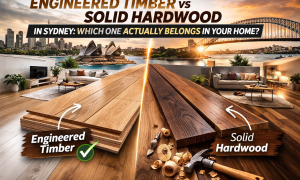
Engineered timber is a multi-layer product. At its core are structural layers of plywood or high-density fibreboard, with a genuine hardwood veneer bonded to the top surface. That construction gives it significantly better dimensional stability than solid timber, which matters a great deal in Sydney’s climate. The city experiences genuine seasonal humidity variation, and solid timber responds by expanding and contracting. Engineered timber handles those changes far more gracefully.
From a practical standpoint, engineered timber installs faster than solid hardwood, requires less subfloor preparation in many cases, and works well in apartments and strata buildings where acoustic requirements must be met. For most Sydney renovation projects, it is the sensible choice. It looks and feels like real timber because the surface layer is real timber, but it performs better in conditions that would stress a solid board over time.
Solid hardwood is a different proposition entirely. Every board is natural timber from top to bottom, and that characteristic is what gives it its most compelling long-term advantage. A solid hardwood floor can be sanded back and refinished multiple times over its life, which means a floor installed today could still look fresh in forty years with the right care. For homeowners who plan to stay in a property long-term, or who are investing in a high-end renovation where resale premium is part of the calculation, solid hardwood justifies its higher cost.
The trade-offs are real, though. Solid hardwood needs time to acclimatise to the conditions of your home before installation, moisture management before and during installation is critical, and the ongoing care requirements are higher than with engineered timber. In the wrong environment or with the wrong preparation, solid timber can cup, bow or gap in ways that are expensive to fix.
For apartments and modern renovations with concrete subfloors, engineered timber is almost always the right answer. For houses with suspended timber subfloors, high-end renovations and owners with a long-term horizon, solid hardwood is worth serious consideration.
What Drives the Final Price Up or Down
Knowing the per m2 rate for your chosen flooring type is only the starting point. The final project cost is shaped by a collection of factors that vary significantly from one home to the next. Understanding them before you get quotes puts you in a much stronger position.
Subfloor Preparation
This is where renovation budgets most commonly blow out, and it is the factor homeowners most consistently underestimate or ignore entirely when planning costs. The condition of your subfloor determines how much preparation work is needed before any flooring goes down, and in older Sydney homes, that preparation can be substantial.
Concrete grinding to remove high spots or old adhesive residue typically costs between $20 and $40 per m2. Installing a moisture barrier over a concrete slab runs $10 to $25 per m2. Levelling compounds to address uneven subfloors vary widely in cost depending on the extent of the problem and the product used. Older homes in suburbs like Parramatta, Ashfield, Leichhardt and Marrickville often have subfloors that require significant attention before a new floor can be properly laid.
The honest advice here is to have your subfloor assessed before you get flooring quotes, or, at a minimum, to ask contractors to inspect it as part of their quote. Any quote that does not address the subfloor condition is incomplete.
Floor Removal
Whatever is on your floor right now needs to come off, and that work is almost never included in a basic flooring supply quote. The cost varies by material.
Material Being Removed
Typical Cost per m2
Carpet and underlay
$10 to $20
Ceramic or porcelain tiles
$30 to $60
Existing timber flooring
$25 to $50
Tile removal is the most expensive because of the time and equipment involved, and because old adhesive underneath tiles usually needs to be ground back before new flooring can go down. Disposal fees apply across most Sydney council areas and are typically charged separately or included as a line item in the quote.
Installation Method
The method used to install your flooring affects both the price and the outcome underfoot. Floating installation is the most affordable approach and the fastest to complete. The boards are not fixed to the subfloor but rather lock together and float as a unit, making the installation straightforward and allowing for natural movement. It is the standard method for most engineered timber installations in apartments.
Glue-down installation bonds the boards directly to the subfloor with adhesive, creating a more solid feel underfoot and eliminating hollow sound when walking. It takes more time and materials than floating, which is reflected in the price. Nail-down installation is the traditional method for solid hardwood over a timber subfloor. It is the most labour-intensive of the three methods and therefore carries the highest installation cost, but it is also considered the most durable long-term fixing method for solid timber.
One important note on patterns: if you are interested in a herringbone or any other patterned layout, factor in a labour cost increase of 30 to 50 per cent over a standard straight lay. The cutting, planning and laying time is substantially higher, and that is reflected directly in what contractors charge.
Timber Species and Origin
Premium Australian hardwood species carry higher price tags than standard imported alternatives, but they also offer qualities that justify the cost in many cases. Blackbutt is one of the most popular choices in Sydney homes, valued for its pale golden colour and durability. Spotted Gum offers a more dramatic grain and natural colour variation that many homeowners find appealing. Tasmanian Oak, despite the name, is actually a collective term covering several eucalyptus species, and it is widely used in both residential and commercial settings.
Imported European oak has surged in popularity over the last several years, particularly in renovation and new build projects targeting the premium end of the market. The natural grey and blonde tones of European oak suit contemporary interiors well, but freight costs and supply chain factors push its price noticeably above Australian species.
Labour Costs in Detail
Labour is the component of flooring pricing that Sydney homeowners most often try to find savings on, and it is also the component where cutting corners carries the most risk. Here is what licensed flooring contractors currently charge for installation work alone, separate from materials.
Standard installation for straightforward layouts runs between $60 and $120 per m2. Complex layouts involving pattern work, staircase installation, tight access areas or significant obstacles push that range to $100 to $180 per m2 or higher. Contractors working in strata buildings carry additional compliance obligations under the Australian Building Codes Board, particularly regarding acoustic underlay requirements and building protection during works, which add time and cost to strata jobs.
The reason licensed contractors cost more than unlicensed operators is straightforward. They carry insurance, they meet code requirements, they provide warranties on their work, and if something goes wrong, you have recourse. In a city where flooring costs can run to $25,000 or more for an average home, the small savings from hiring an unlicensed operator are not a saving worth taking.
How Hardwood Compares to Other Flooring Options
It is worth understanding where hardwood sits relative to other flooring options on the market, both in terms of cost and value over time.
Flooring Type
Installed Cost per m2
Laminate
$90 to $150
Hybrid
$120 to $200
Engineered Timber
$160 to $280
Solid Hardwood
$200 to $350+
Laminate is the most affordable option, but it has real limitations. It cannot be refinished, it looks synthetic up close, and in the Sydney property marke,t it is not considered a premium finish by buyers or real estate agents. Hybrid flooring has improved significantly in quality and is a reasonable choice for high-traffic areas or rooms with moisture exposure, but it does not carry the same resale appeal as timber. Engineered and solid hardwood sit at the top of the cost table, but they also sit at the top of the value table for most Sydney properties.
Is Hardwood Flooring Worth the Investment in Sydney?
In a property market like Sydney’s, the answer is yes for most homeowners. Timber flooring consistently registers as a preferred finish among buyers at inspection, and real estate agents in mid to high-value suburbs will tell you directly that timber floors improve both buyer appeal and achievable sale price. Rental properties with timber flooring also attract stronger demand and often achieve better weekly rates than equivalent properties with carpet or laminate.
The lifespan argument matters too. A well-installed hardwood floor, maintained properly, will last 20 to 40 years. Over that period, the cost per year is very competitive with cheaper alternatives that need replacing every 10 to 15 years. When you factor in the disruption and cost of replacing flooring, the higher upfront investment in hardwood often looks very sensible in the long term.
Hardwood also performs better thermally than tiles in both summer and winter conditions, which contributes to comfort in a way that is easy to underestimate until you have lived with it.
How to Keep Your Flooring Costs Under Control
There are genuine ways to manage the cost of a hardwood flooring project without compromising on quality or cutting corners that matter.
Choosing engineered over solid hardwood is the single biggest saving available to most homeowners, and it does not require any meaningful sacrifice in appearance or performance for most Sydney homes and apartments. Sticking to a straight lay pattern rather than herringbone or other complex layouts significantly reduces labour costs. Sorting out your subfloor preparation before installers arrive, rather than leaving it to be managed on the day, can save time that would otherwise be charged at contractor rates.
Larger projects attract lower per m2 rates because fixed overhead costs are spread across a larger area. If you are on the borderline between doing one room now and another later, it is often worth combining the work. And getting at least three quotes from licensed contractors before committing is not just good practice; it gives you real market data on what the job should cost.
Mistakes That End Up Costing Sydney Homeowners More
The same mistakes appear repeatedly in flooring projects that run over budget or run into problems after installation.
Underestimating subfloor preparation costs is the most common. It is almost always treated as a line item that can be trimmed, and it almost always turns out to be more significant than expected. Budget for it properly from the start.
Skipping moisture testing before installation is a mistake that can have expensive consequences. Timber and moisture are genuinely incompatible over time, and a moisture test that costs a couple of hundred dollars can identify a problem that would otherwise destroy a floor worth tens of thousands. It is not optional for any serious job.
Choosing a timber species without considering how it will perform in your specific conditions is another frequent issue. Sydney’s climate varies by suburb and by season, and not every species handles those variations equally well. Ask your contractor specifically about how your chosen timber performs in local conditions.
Hiring unlicensed installers is a false economy in almost every case. The savings on the job cost are real. The risk of substandard work with no warranty and no recourse is also real, and it tends to be much more expensive to fix than the original saving.
Not budgeting a contingency of at least 10 to 15 per cent on top of your quoted cost leaves you exposed to the variations that almost every renovation project encounters. That contingency is not pessimism. It is financial planning.
Final Word
Hardwood flooring in Sydney in 2026 is a meaningful financial commitment. For a typical home, you should be planning to spend somewhere between $18,000 and $28,000 all in, with the final figure depending on the timber you choose, the condition of your subfloor and the complexity of the installation. That number is not small, but in the context of Sydney property values and the longevity of a well-installed timber floor, it is a spend that tends to hold its value well.
The homeowners who navigate this process most successfully are the ones who go in with a complete picture of the costs involved, not just the supply price per m2. They account for preparation, removal, disposal and contingency from the beginning. They get multiple quotes from licensed contractors and compare them on total installed cost. And they make their timber choice based on the specific conditions of their home rather than just aesthetics or price alone.
Do that groundwork before you commit to anything, and you will be in a strong position to get a result you are genuinely happy with for a long time to come.
Frequently Asked Questions
How much does hardwood flooring cost per m2 in Sydney in 2026?
Installed pricing currently ranges from $160 to $350 per m2, depending on the timber type and the complexity of the job. Engineered timber at the lower end of that range and solid hardwood at the upper end.
Is engineered timber cheaper than solid hardwood?
Yes. Once installation is included, engineered timber typically comes in $40 to $80 per m2 cheaper than solid hardwood. Over an 80m2 project, that difference is meaningful.
How long does installation take?
A standard 80 m2 installation takes three to five days for an experienced crew. Add time for subfloor preparation, which is often identified and scoped properly only once the existing floor has been removed.
Will timber flooring increase my property value?
In Sydney’s property market, it consistently does. Buyers at the middle and upper ends of the market view timber flooring as a premium finish and factor it into their willingness to pay. Real estate agents in well-performing suburbs will confirm this directly.
Do I need council approval?
Not for standard internal renovations in freestanding homes. Strata properties are a different matter. You will need to meet the acoustic requirements set out in your building’s bylaws before work can begin, and approval from the owners’ corporation is typically required.
All In One Renovations
All In One Renovations is a Sydney-based renovation specialist sharing practical advice, design ideas, and real-world tips to help homeowners plan smarter upgrades. With hands-on industry experience, the team writes about Flooring, Kitchens, Bathrooms, extensions, and full home renos, making the process easier to understand and less stressful for everyday Aussie homeowners.







 0451 878 711